

Tax Season Scams Are Starting Early: The W-2 Scam Hitting Small Businesses First
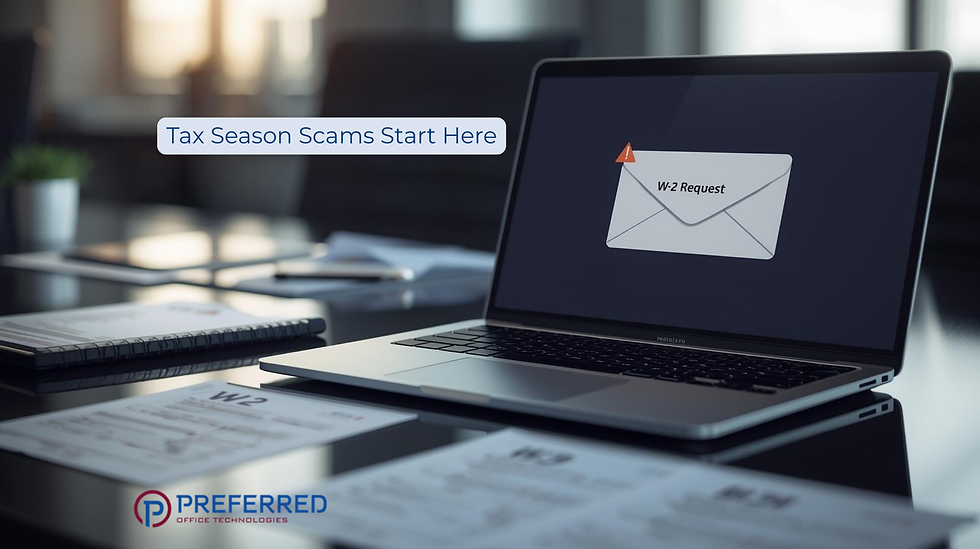
Tax season is ramping up across Northwest Arkansas, the Greater River Valley, and the Tulsa Oklahoma Metro.
Your accountant is getting busier. Your bookkeeper is pulling reports. Payroll is finalizing W-2s and 1099s.
But the first real tax-season problem most small businesses face isn’t a form.
It’s a scam.
And there’s one attack that shows up early every year because it’s simple, believable, and devastating for small businesses.
Chances are, it’s already landed in someone’s inbox.
What Is the W-2 Scam?
The W-2 scam is one of the most common tax season cyberattacks targeting small businesses.
Here’s how it works:
An employee in payroll, HR, or finance receives an email that appears to come from:
The business owner
The CEO
A senior executive
The message is short and urgent:
“Hey, I need copies of all employee W-2s for a meeting with the accountant. Can you send them over ASAP? I’m slammed today.”
Nothing about it feels suspicious.
It’s tax season.W-2s are expected. The sender looks legitimate.
So the employee sends the files.
Except the email wasn’t from leadership.
It was from a cybercriminal using:
A spoofed email address
A look-alike domain
Or a compromised inbox
Now the attacker has every employee’s:
Full legal name
Social Security number
Home address
Salary information
Everything needed for identity theft and tax fraud.
What Happens After a W-2 Scam
Most businesses don’t discover the breach immediately.
They find out when employees start getting IRS rejection notices:
“A tax return has already been filed using this Social Security number.”
Someone else already filed in their name. Someone else already collected the refund.
Now your employees are dealing with:
Identity theft resolution
Credit monitoring
IRS investigations
Months of paperwork
And your business is dealing with:
A major trust issue
Potential legal exposure
Reputational damage
Long-term employee frustration
This isn’t just an IT problem.
It’s an HR, legal, and leadership problem.
Why the W-2 Scam Works So Well on Small Businesses
This attack succeeds because it doesn’t look like a scam.
It works because:
The timing is perfect February is when W-2 requests are normal.
The request is reasonable No wire transfers. No gift cards. Just documents that really do get shared.
The urgency feels natural “I’m slammed today” sounds exactly like tax season.
The sender looks real Cybercriminals research your business, leadership, and vendors.
Employees want to help Especially when the request appears to come from the boss.
In busy offices across Fort Smith, Fayetteville, Van Buren, Rogers, Bentonville, and Tulsa, urgency often overrides verification.
That’s exactly what attackers count on.
How Small Businesses Can Prevent the W-2 Scam
The good news: this scam is highly preventable without expensive tools or complicated changes.
1. Create a “No W-2s via Email” Rule
No exceptions.W-2s and payroll documents should never be sent by email attachment even internally.
2. Verify Sensitive Requests Using a Second Channel
Any request involving:
Payroll data
Employee tax forms
Banking changes
Must be verified by phone, chat, or in person using known contact information.
3. Hold a 10-Minute Tax Scam Awareness Huddle
Tell payroll and HR teams:
These scams are increasing now
What they look like
Exactly what to do
Awareness is one of the strongest defenses.
4. Lock Down Payroll and HR Systems
Enable multi-factor authentication (MFA) on all systems that store employee data.
If credentials are stolen, MFA stops the attack cold.
5. Reward Verification, Not Speed
Employees who double-check requests should be praised not questioned.
When verification is encouraged, scams fail.
Tax Season Brings More Than One Scam
The W-2 scam is just the beginning.
Between now and April, businesses across Arkansas and Oklahoma will see:
Fake IRS payment notices
Phishing emails posing as tax software updates
Spoofed messages from “your accountant”
Fraudulent invoices disguised as tax expenses
Businesses that avoid these attacks aren’t lucky they’re prepared.
Is Your Business Ready for Tax Season Scams?
If you already have:
Clear payroll policies
MFA in place
Email protections against spoofing
You’re ahead of most small businesses.
If not, now is the time before the first scam hits.
👉 Book your FREE Managed IT Risk Assessment https://8918038.hs-sites.com/free-managed-it-risk-assessment
Because tax season is stressful enough identity theft shouldn’t be part of it.


Comments