

The Hidden Impact of Disconnected Systems on Your Business

Technology is supposed to make work easier. But what happens when every system works, just not together?
Your accounting software may work perfectly. Your CRM may do exactly what it was designed to do. Your document management system, communication tools, and other business applications may all be doing their individual jobs.
But if information can't move easily between them, your employees often become the connection.
They copy information from one system to another. They search through emails for documents. They update the same information in multiple places. They ask coworkers for information that exists somewhere else in the organization.
Individually, those moments may not seem significant. Across an entire business, every day, they can add up quickly.
Disconnected Doesn't Mean Broken
One reason disconnected technology can be difficult to recognize is that nothing necessarily appears to be wrong.
The applications are running. Employees can access what they need. Work is getting done.
The problem is often how much effort it takes to get that work done.
When systems operate independently, employees may spend more time locating information, moving data between applications, verifying which version is correct, or completing extra steps simply because one system doesn't communicate with another.
Those inefficiencies can become so familiar that they are eventually accepted as part of the job.
What Are Connected Business Systems?
Connected business systems allow different technologies and applications to share information and support the flow of work across your organization.
Instead of employees having to manually move information from one system to another, connected systems can help information move more efficiently between people, departments, and processes.
The goal isn't necessarily to replace the technology you already use. It's to make sure those systems support the way your business actually works.
Look at the Handoffs
A good place to uncover disconnected systems is anywhere information has to move from one person, department, or application to another.
Consider what happens when a new customer is added, an order is processed, a document needs approval, a service request comes in, or information needs to move from sales to administration.
Ask a few simple questions:
Does someone have to enter the same information more than once?
Is information being copied and pasted between systems?
Are employees emailing documents back and forth because systems don't share them?
Does someone have to contact another department just to find the status of something?
Are spreadsheets being used to bridge information between other applications?
Those extra steps can be signs that the individual technology is working, but the overall system isn't working as efficiently as it could.
The Impact Reaches Beyond Your Employees
Disconnected systems don't just affect internal productivity.
A customer may have to provide information they've already given you. An employee may need additional time to answer a question because information is stored somewhere else. A request may wait because the next person in the process doesn't know it's ready for them.
From the customer's perspective, they don't see disconnected software.
They experience delays, repeated questions, inconsistent information, and extra steps.
That makes connected systems more than an IT issue. They can directly affect how easy it is to do business with your organization.
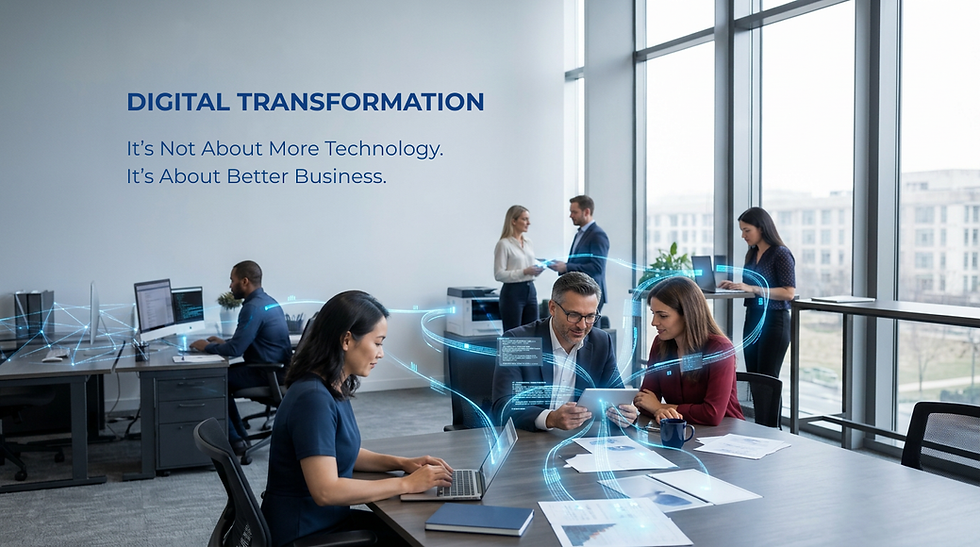
When businesses hear “digital transformation,” it's easy to assume that improving technology means replacing existing systems.
Often, it doesn't.
The better starting point is understanding what you already have and how information moves between those systems.
Some applications may already offer integrations you're not using. Existing workflows may be able to automate a handoff. A document management system may be able to connect information that currently lives in separate places.
The goal isn't to connect technology simply because you can.
The goal is to remove unnecessary friction from the way work gets done.
Start With One Process
You don't have to map your entire technology environment to begin identifying opportunities.
Choose one common business process and follow it from beginning to end.
Where does the information start?
Who touches it?
Which systems are involved?
Where does someone have to manually move information?
Where does the process slow down?
Those points of friction can tell you a great deal about where disconnected systems are affecting everyday operations.
Sometimes the biggest opportunity isn't another piece of technology.
It's getting the technology you already have to work together.
Building a More Connected Business
Digital transformation isn't about connecting every application or automating every task. It's about creating an environment where technology supports the way your business needs to operate.
When systems, information, and people can work together more effectively, employees spend less time navigating technology and more time using it to get work done.
And that's when technology begins doing what it was supposed to do in the first place: making business better.
Next Week in Intelligent Systems Insights
Every extra manual step may seem small, but repeated across your team, those steps can quietly consume hours of productive time.
Next week, we'll look at Manual Processes and how outdated processes may be costing your team more time than you realize.


Comments